
Artificial Intelligence: The Consequences of "Scale at All Costs."
Especially on you and me.

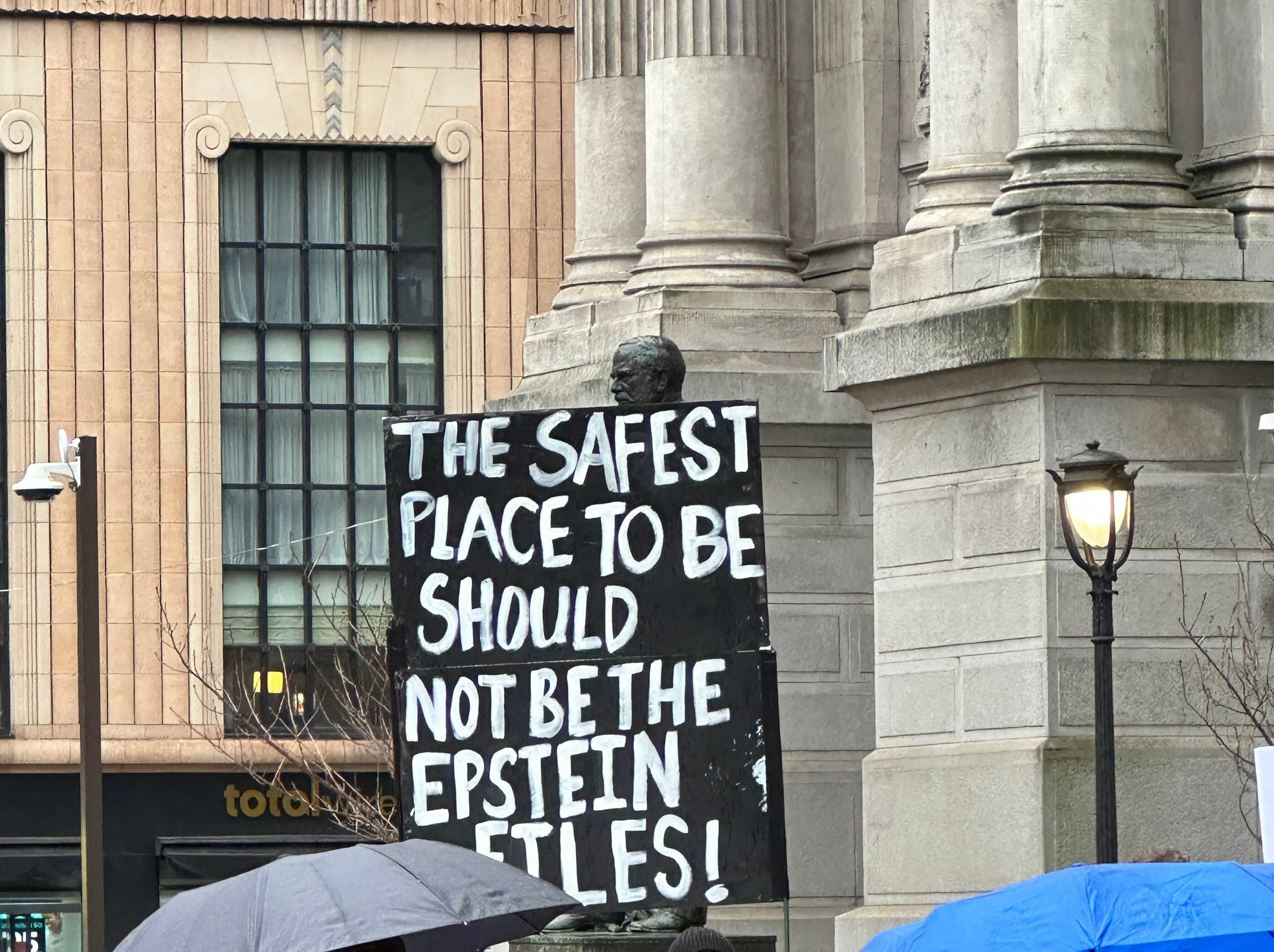
Philadelphia, Pennsylvania (published in Robert Hubbell’s “Today’s Edition” Substack newsletter, Jan. 14, 2026).
This article picks up where an earlier article on Artificial Intelligence leaves off. In many ways, we are the people AI has been waiting for.

The people who benefit the most from Artificial Intelligence (AI) are its rulers. What has aptly been called “the empire of AI” began in the United States in Silicon Valley. The Silicon Valley approach to AI development has also been called a “scale at all costs approach” by Karen Hao, a highly respected journalist who has been researching AI ways and means for decades.[i] In response to this approach to AI development, 3,400 employees at Amazon, Google, and Apple signed an open letter that originated with Amazon employees or have otherwise signaled their support for it. In their letter, they called out Silicon Valley’s “all-costs-justified, warp-speed approach to AI development” and its consequences. Those possible, even likely, consequences include, the employees of AI said, “staggering damage to democracy, to our jobs, and to the earth[.]”[ii]
Silicon Valley’s “scale at all costs approach” means that even the most conservative predictions of AI development along that path will almost certainly mean significant increases in the amounts of energy and water that AI’s data centers are consuming, now and in the future.[iii]
In order to understand the issues resulting from the approach that governs the rollout of AI in the United States at least, which is firmly in the hands of Silicon Valley, we need to begin by understanding Silicon Valley’s approach to the manufacture and distribution of AI. It must be clearly understood from the beginning that this is not the only approach to using AI;, but that it is the prevailing approach, for now. Otherwise, nothing wonderful can come of our story, as Dickens wrote at the beginning of a fictional story nearly two centuries ago.
The difference here, of course, is that this story is not fiction.
AI is generated in large data centers. “Data centers are large buildings that house rows of computer servers, data storage systems and networking equipment, as well as the power and cooling systems that keep them running.”[iv] Stated differently, data centers are “vast warehouses containing networked servers used for the remote storage and processing of data” including in the production of AI, and they are also used “by information technology companies to train AI models[.]”[v]
The centers run extraordinarily hot because they process amounts of information which dwarf previous data inputs. To keep the data centers from overheating, Silicon Valley’s approach demands both water and electricity. It is less expensive for many companies to use water as a coolant as distinct from, say, air-conditioning units. Water is run through the servers to keep them cool enough to continue operating.
The same data centers also need electricity, and lots of it. For this reason, Silicon Valley has decided on generating electricity in the large amounts it needs from coal and gas plants, and even from nuclear power plants. Those plants in turn also require large amounts of water to keep cool.[vi]
Data centers are located everywhere across the entire nation. They are located in cities everywhere in the land, but mostly in the cities of Atlanta, Chicago, Columbus, Dallas, Des Moines, Phoenix, Santa Clara, and assorted cities in Northern Virginia including Manassas.
The States of Virginia, Texas, and California have the most data centers at present, but there are also large numbers of data centers in Arizona, Georgia, Illinois, Iowa, and Ohio.[vii]
Now that we have a working definition of data centers and a broad understanding of their locations, a closer look at AI data centers’ thirst for water and consumption of electricity will come in handy for us if we want to better understand the ways in which Silicon Valley’s model for AI development affects the issues behind the AI platform.
A. Water.
As is often the case in this past year or so, transparency in what is going on is a continuing problem. It is difficult to isolate data center water usage since no figures are as yet given or required of their owners. Water usage is provided by companies for their whole operations, but not for individual data centers or for data centers collectively.
For example, Amazon as a whole used 105 billion gallons of water in 2021. That’s the equivalent of 958,000 households.[viii] It is also roughly the same amount of water that is taken from the Colorado River to grow winter vegetables every year in California’s Imperial Valley.[ix] Recently published research estimates that water use related to the production of AI is now greater than the entire world’s demand for bottled water.[x] The Pew Research Center reports an estimate that data center water usage amounted to 17 billion gallons in 2023.[xi]
The potential for adverse results for us, if not for the billionaires who own AI production, should be obvious from AI data centers’ unparalleled use of unimaginable amounts of water. Without water, people, animals, and plants all die. If water is diverted to the production and sale of AI in such large amounts, it is obvious that less water will be available for anyone or anything else. Man-made droughts would almost certainly trigger liability claims along with corresponding claims to insurance coverage for their consequences, including deaths. The breadth and depth of discovery in civil litigation would be unparalleled then.
So much is possible, even likely, from what has been said so far about AI data centers’ incomparable consumption of water. There is more.
To be continued in future articles.
[i] Interview by Amy Goodman and Juan Gonzalez with Karen Hao, author of The Empire of AI, in New York, New York, May 2025 on Democracy Now (broadcast Jan. 1, 2026).
[ii] Paresh Dave, Amazon Workers Issue Warning About Company’s ‘All-Costs-Justified’ Approach to AI Development, WIRED (Nov. 26, 2025), https://www.wired.com/story/amazon-employees-open-letter-artificial-intelligence-layoffs/.
[iii] See Xiao, et al., Nature Sustainability (Nov. 10, 2025), supra, at 1542. See, in addition, Oliver Milman, More Than 200 Environmental Groups Demand Halt to New US Datacenters, The Guardian (Dec. 8, 2025), https://www.theguardian.com/us-news/2025/dec/08/us-data-centers.
[iv] Rebecca Leppert, Analysis / What We Know About Energy Use at U.S. Data Centers Amid the AI Boom, Pew Res. Ctr. (Oct. 24, 2025), at section on “What’s a Data Center?”, https://www.pewresearch.org/short-reads/2025/10/24/what-we-know-about-energy-use-at-us-data-centers-amid-the-ai-boom/.
[v] Luke Barratt, The Guardian (April 9, 2025), supra.
[vi] Jake Bittle, Amazon Says it’s Going ‘Water Positive’ -- But There’s a Problem, Grist (Aug. 29, 2024), https://grist.org/technology/amazon-data-centers-water-positive-energy/. Amazon’s water consumption goals do not include figures for reducing the water consumed by the power plants that provide power to its data centers, which can run between 3 and 10 times greater than water consumption at the data centers themselves. Id.
[vii] See Pew Research Center Analysis, supra, tbl. “Number of data centers, by market,” in section at “Virginia, Texas, and California lead in number of data centers.”
[viii] Luke Barratt and Rosa Furneaux, Technology / Amazon Strategised About Keeping its Datacentres’ Full Water Use Secret, Leaked Document Shows, The Guardian (Oct. 25, 2025), https://www.theguardian.com/technology/2025/oct/25/amazon-datacentres-water-use-disclosure.
[ix] Jake Bittle, Grist (Aug. 29, 2024), supra.
[x] E.g., de Vries, Carbon and Water Footprints of Datacenters and AI, (Jan. 9, 2026), supra; Robert Booth, 2025’s AI Boom Caused Huge CO2 Emissions and Use of Water, Research Finds, The Guardian (Dec. 18, 2025), https://www.theguardian.com/technology/2025/dec/18/2025-ai-boom-huge-co2-emissions-use-water-research-finds.
[xi] Pew Research Center Analysis, supra, at section titled, “What is energy used for at data centers?” The estimate of 17 billion gallons is attributed to the U.S. Department of Energy in Dara Kerr, The AI Boom is Heralding a New Gold Rush in the American West, The Guardian (Dec. 4, 2025), https://www.theguardian.com/technology/2025/dec/04/nevada-ai-data-centers.
When are we going to learn? The financial services industry promised growth and new services in exchange for the deregulation of the financial services industry in the late 1990s and 2000s. What we actually got were toxic financial instruments that spread systemic risk and caused economies around the world to collapse in 2008, followed by public bailouts with taxpayer money. Now evangelists for AI, the leaders of maybe 7-10 companies who will reap most of the profits from AI, have convinced the Trump administration to leave AI unregulated. They claim that unless we trust them to protect the public against the dark side of AI, we will lose the race to develop AI to the Chinese.
Just last year, they assured us that they would not monetize AI in ways that harm the public. We were told that guardrails were in place to prevent AI from generating porn or manipulating public opinion through individually targeted advertising. But less than a year later porn has proliferated across most AI platforms and AI is now being used to generate targeted advertising. Given the need to recoup the trillions of dollars being invested in AI infrastructure around the world, what else could go wrong? Dennis effectively explains the costs currently being imposed on the public by AI, what economists call “externalities.” I don’t know if the warnings about AI eliminating millions of jobs or, God forbid, turning against the human race are valid. I do know that I’d rather rely on ground rules established by government agencies the proper expertise than the whims of a handful of tech billionaires to protect us.